How to start an airsoft team: checklist, roles, radios and rules

TL;DR
To start an airsoft team, get four to six people who already play, decide whether you are a casual skirmish or milsim team, then pick a home field, a name, one team colour, matching radios and one page of rules. Expect two to three months from the first group chat to turning up organised. The most common mistake is recruiting widely before you agree what kind of team you are.
Key takeaways
- Start with four to six committed founders, one of whom will do the admin.
- Decide skirmish or milsim first: it sets kit rules, training time and events.
- Everyone gets the same licence-free radio model, a written channel plan and a callsign.
- Give each role to one named person: lead, comms, maps, safety and admin.
- Write one page of rules covering eye protection, honest hit calling and conduct.
On this page
To start an airsoft team, get four to six people who already play, agree whether you are a casual skirmish team or a milsim team, pick a home field, a name and one team colour, set up radios and a channel plan, write short rules, then play your first game together. Going from a group chat to a team that turns up organised usually takes two to three months. The most common mistake is recruiting widely before you have agreed what kind of team you are.
What you need to start an airsoft team
Airsoft is played in several formats, including skirmishes, close quarters battle games, military simulations and historical reenactments, on indoor and outdoor fields.[1] Your team does not need to cover all of them. It needs a clear answer to “what do we play, where, and how often”.
How many people do you need for an airsoft team?
Four to six committed founding members is enough to start. That is small enough to agree on a game day and big enough to still field a squad when two people drop out. You can grow later; you cannot fix a team of twelve that never agrees on a date.
Here is the short list. Tick every line before your first game as a team:
- People: four to six founders, one of whom is willing to do admin.
- A home field: one site you all play at regularly. Pick somewhere everyone can reach in under an hour, or attendance drops fast.
- Kit: each player’s own gear, plus one agreed team colour or patch.
- Radios: one licence-free radio per player, same model where possible, so channels and settings match.
- Apps: a group chat for planning and a shared map for game day.
- Rules: one page covering safety, conduct and who decides what. Keep it short enough that people read it.
If you lean towards milsim, budget early. At the largest milsim events, players must often source their own equipment, such as specific uniforms and radios.[2]
The checklist: from first group chat to first game
Play the first team game at a field everyone already knows, so the only new thing on the day is playing together.
| When | Task | Owner |
|---|---|---|
| Weeks 1 to 2 | Agree team type (skirmish or milsim), game days and a rough budget | All founders |
| Weeks 1 to 2 | Pick a home field and play there together | Team lead |
| Weeks 3 to 4 | Choose a name and one team colour or patch | All founders |
| Weeks 3 to 4 | Write one page of team rules and a safety standard | Safety lead |
| Weeks 5 to 6 | Buy matching radios, write the channel plan and callsigns | Comms lead |
| Weeks 5 to 6 | Set up the shared map and the group chat | Maps lead and admin |
| Week before | Confirm who is coming, kit check, charge radios and phones | Admin and safety lead |
| Game day | Radio check, map check, brief the plan in the car park | Team lead |
| After | Short debrief in the chat, book the next date | Admin |
How to start an airsoft team in 10 steps
Step 1: Decide what kind of team you are
Choose between a casual skirmish team and a milsim team before anything else, because that choice sets your kit rules, training time and which events you enter. Large milsim events usually have rigid requirements for entry and can last several days without leaving the playfield.[2] A skirmish team can start with whatever kit people own.
Step 2: Recruit four to six founding members
Start with people you already play with. Agree on how often you will play (for example, one Sunday a month) and who handles admin before you invite anyone else.
Step 3: Pick a home field
Play together at one site until the staff know your faces. In the UK this has a practical side: most sites take part in the UKARA registration scheme, under which a player with at least 3 skirmishes over at least 56 days at one site can be registered by that site.[1]
Step 4: Choose a team name
A good name is short, easy to say over a radio and different from every other team at your home field. Check the field’s social pages before you order patches. Patterns that work:
- A local feature: a river, hill or forest near your field.
- An animal plus a colour: easy to picture, easy to put on a patch.
- A phonetic letter plus a number: it doubles as your radio callsign.
Avoid real military unit names and insignia.
Step 5: Set your team identity
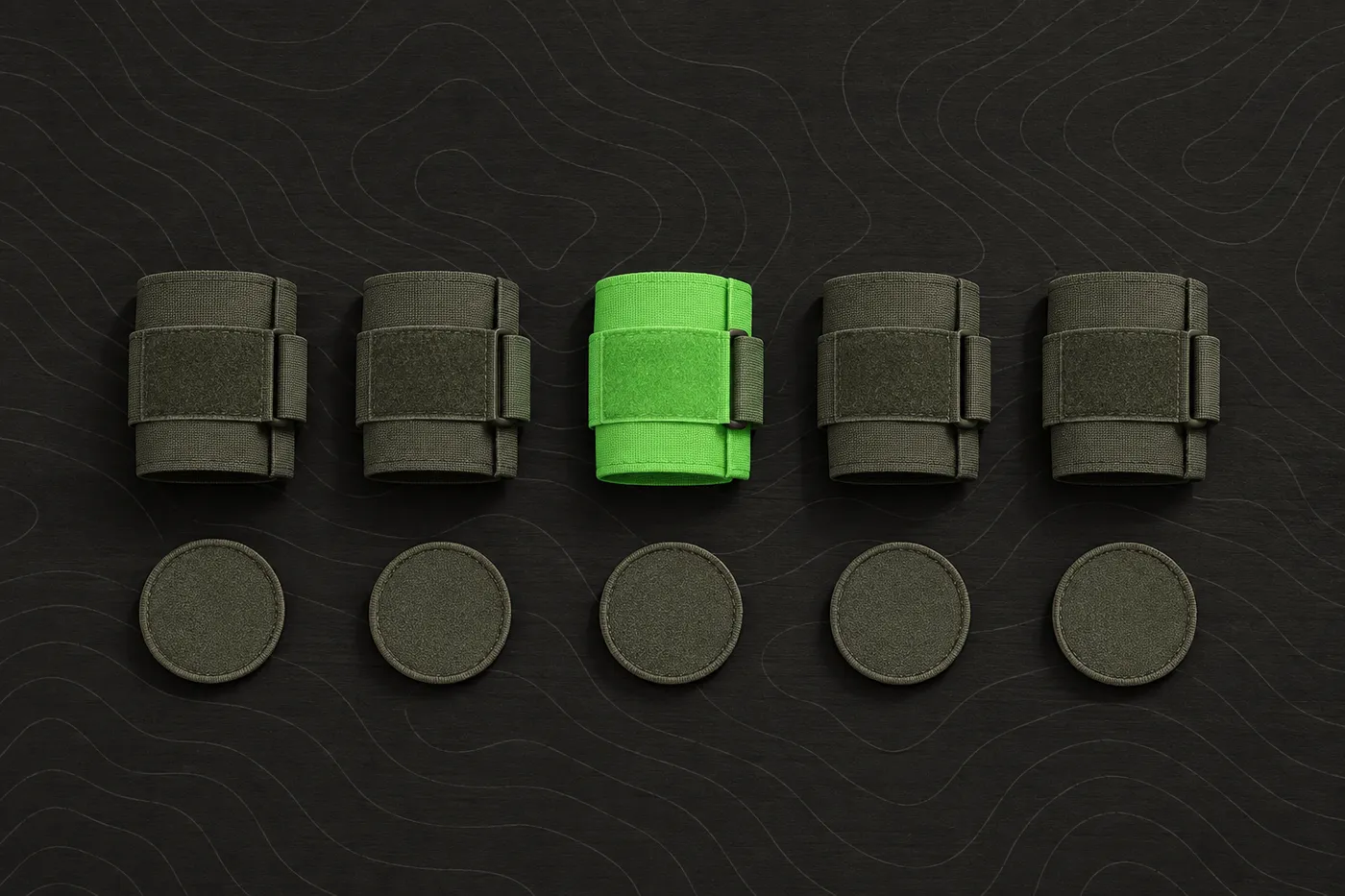
Pick one team colour (armband, patch or tape) so teammates recognise each other at a glance across a field. Keep the patch design plain and original.
Step 6: Set up comms
Buy the same licence-free radio model for everyone, write a channel plan and give everyone a callsign. The comms section below has the detail.
Step 7: Give every role to one named person
Team lead, comms, maps, safety and admin. See the roles table below.
Step 8: Write your rules and safety standard
One page: safety kit, honesty about hits, how to treat staff and other teams, and who decides disputes.
Step 9: Train, then play your first game as a team
Run one practice session (radio checks, moving as a group, calling hits honestly), then play a normal game day at your home field.
Step 10: Recruit and keep it running
Recruit only after the first few games, from players you have met at the field. Rotate the booking and the game-day message so no single founder carries the team.
Comms: radios, a channel plan and callsigns
In Europe the usual choice is PMR446, a licence-exempt personal radio service available for business and personal use in most EU countries and the UK, with 16 analogue FM channels.[3] The US, Canada and Mexico use the Family Radio Service instead, and radios approved for FRS are not legal to operate anywhere in Europe.[4] Buy radios for the country you play in.
A simple channel plan for a team of six:
- Team channel: your main channel for the whole game.
- Backup channel: where you move if the main one is busy.
- Event channel: whatever the organiser uses for staff and safety calls.
Radio privacy codes (CTCSS and DCS tones) only help reduce unwanted audio when sharing busy channels; they offer no protection from eavesdropping.[4] Assume other teams can hear you.
Give everyone a short callsign and use one call format. In standard radio voice procedure, the station being called is named before the station calling, so a call opens with the other callsign, then yours.[5] “Blue two, this is Blue one” is clearer than “Hey, it’s me”.
Bottom line: one radio model, one written channel plan, one callsign each. Do a radio check in the car park before the first game starts.
Radios carry voice. A shared map carries position, so nobody has to describe where they are.
Tacnav is a free iPhone app where one person creates a session and shares a QR code, and the team scans it to appear on the same map.[6] Squads show up in their own colours, anyone can drop markers for objectives or hazards, and the session chat keeps the plan in one place. Get it on the App Store; Android is in closed beta, so request Android access.
If the events you attend already run ATAK on a shared TAK server, use that instead of adding a second map app. Our plain-English guide to ATAK explains when it is the better tool.
Roles inside a small airsoft team
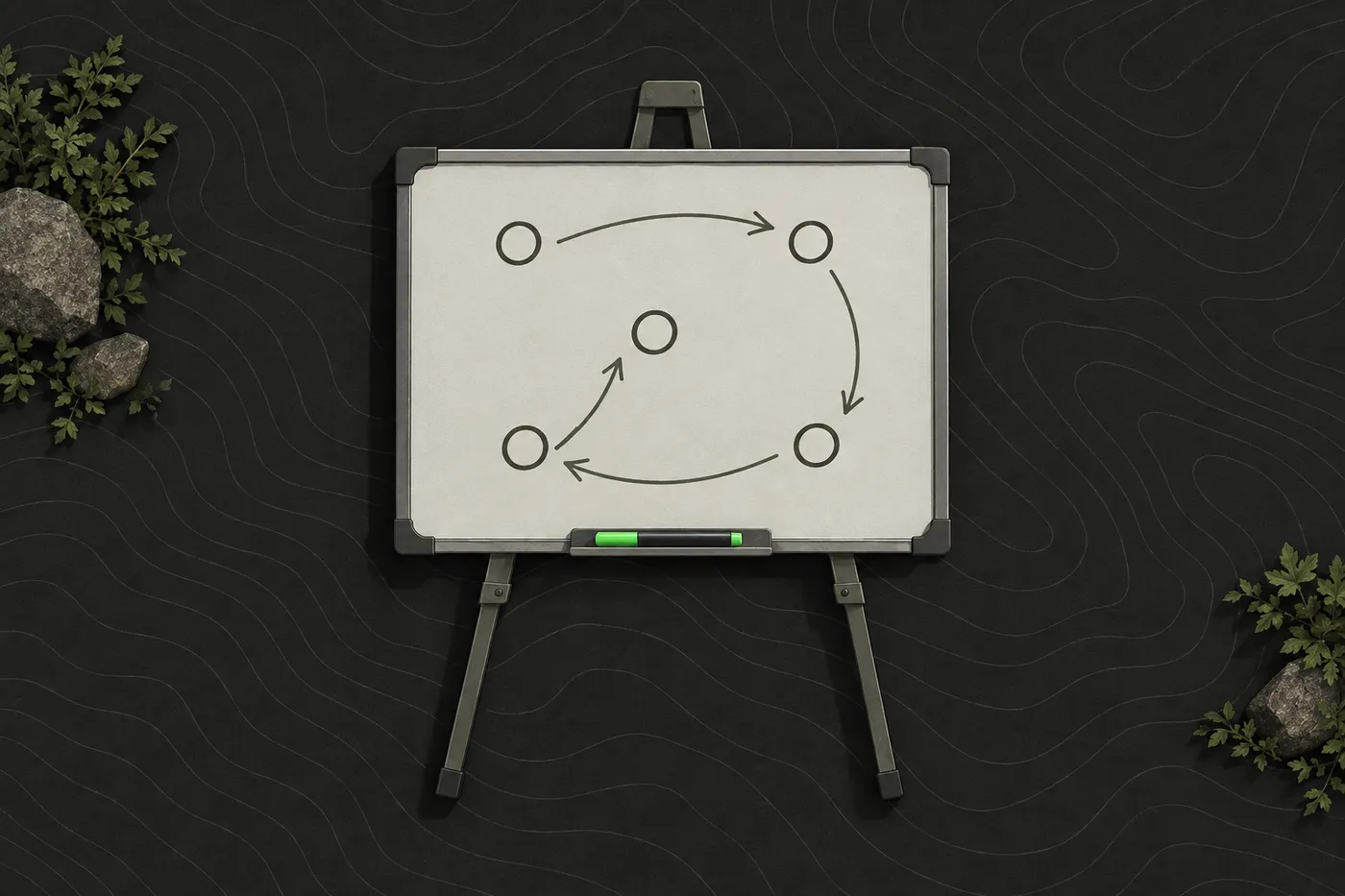
Milsim play often uses fireteams with designated roles, such as simulated combat medics and support gunners.[2] A new team needs something simpler first: in a team of four to eight, give each role to one named person.
| Role | Owns | Needs |
|---|---|---|
| Team lead | Game-day plan, final decisions, the car park brief | A clear plan and the event's rules |
| Comms lead | Radios, channel plan, callsigns, radio checks | Spare batteries, a printed channel card |
| Maps lead | The field map, rally points, the shared map session | A charged phone, a paper map as backup |
| Safety lead | Eye protection checks, chrono, first aid kit, the medical plan | A basic first aid kit and the field's safety rules |
| Admin | Bookings, payments, the group chat, the next date | The field's booking page and everyone's availability |
Safety rules and a team code of conduct
Your team rules should match or exceed your field’s. These are common event norms, not law; your field’s rules always win.
- Eye protection: the minimum gear to take part in most airsoft games includes ANSI Z87.1 eye protection, and full-face coverings are recommended at most airsoft fields.[1]
- Velocity and distance: in the US, close quarters battle arenas typically limit airsoft guns to around 350 fps (110 m/s), and most minimum engagement distances are 10 feet (3 m).[1] Chrono at the field before play and stay under its limit.
- Hits: airsoft pellets do not leave visible marks, so the sport relies heavily on an honour system in which players acknowledge being hit.[1] Call your hits loudly and every time.
- Safe zone: barrel covers on and magazines out before you walk off the field.
- Medical plan: know where the first aid kit is, who the marshals are and how to call them.
Safety: eyes stay protected from the moment you enter the playing area until you are back in the safe zone. No exceptions for fogging or photos.
Organisers take conduct seriously. MilSim West’s published golden rules say participants found cheating or disrespecting the staff and other participants will be ejected from the event without a refund.[7] Put the same standard in your team rules: one warning, then you are off the team.
Common mistakes when starting an airsoft team
- Recruiting before agreeing the basics. A big chat full of people who never play. Fix: agree team type, rules and game days first, then recruit from players you have met.
- One founder doing all the admin. The team stalls when that person gets busy. Fix: rotate booking and the game-day message.
- Mixed radios. Half the team cannot hear the other half. Fix: one model, one channel plan, checked in the car park.
- Buying kit before choosing a type. Milsim kit for a skirmish team, or the reverse. Fix: decide the type in week one.
- No written rules. Arguments on the field about hits and conduct. Fix: one page, agreed by all founders, before the first game.
Disclaimer: This guide is general information for airsoft, milsim and paintball games and for people learning about publicly available TAK software, not military, tactical or legal advice. Follow your field’s and event’s safety rules, marshal instructions and local law. ATAK, iTAK, WinTAK and TAK Server belong to their respective owners; Tacnav is independent, not affiliated with the TAK Product Center, and not compatible with TAK or Cursor on Target. App features and prices change, so check the official listing before you rely on one.
Sources
- Airsoft. Wikipedia, accessed Sep 25, 2026.
- MilSim. Wikipedia, accessed Sep 25, 2026.
- PMR446. Wikipedia, accessed Sep 25, 2026.
- Family Radio Service. Wikipedia, accessed Sep 25, 2026.
- Procedure word. Wikipedia, accessed Sep 25, 2026.
- Tacnav. App Store, accessed Sep 25, 2026.
- TACSOP/DOCS. MilSim West, accessed Sep 25, 2026.
Frequently asked questions
How many people do you need to start an airsoft team?
Four to six committed founding members is enough. That is small enough to agree on a game day and big enough to still field a squad when two people drop out.
How do you name an airsoft team?
Pick a name that is short, easy to say over a radio and different from every other team at your home field. Patterns that work are a local feature, an animal plus a colour, or a phonetic letter plus a number that doubles as a callsign. Avoid real military unit names and insignia.
What radios should an airsoft team use?
In most of the EU and the UK, teams use licence-exempt PMR446 radios, which have 16 analogue FM channels. The US, Canada and Mexico use the Family Radio Service instead, and FRS radios are not legal to operate anywhere in Europe, so buy radios for the country you play in.
Do radio privacy codes stop other teams hearing you?
No. Privacy codes (CTCSS and DCS tones) only help reduce unwanted audio on a busy channel and offer no protection from eavesdropping, so assume other teams can hear you.
What safety rules should an airsoft team have?
At minimum, eye protection rated to ANSI Z87.1, honest hit calling, barrel covers on in the safe zone and a known medical plan. Your field's rules on velocity limits and minimum engagement distance always win.
Tacnav
Put your whole team on one live map.
Positions, markers, routes and chat in a private session. Join with a QR code, no server to set up.