FRS vs GMRS: which radio service your airsoft team needs

TL;DR
FRS is a license-free radio service that covers most single-day airsoft games on one field. GMRS needs an individual FCC license but adds repeaters and a realistic range of one to twenty-five miles, which is worth it for recurring milsim ops or a family running a team together.
Key takeaways
- FRS needs no individual license, but its antenna is built into the unit and can't be upgraded.
- GMRS requires an individual FCC license, valid for a ten-year term.
- GMRS permits repeaters, giving a realistic range of one to twenty-five miles.
- A GMRS license covers the licensee and their immediate family, so a mixed group of friends may need separate licenses.
- Transmitting on GMRS without a license, or coverage under one, breaks FCC rules.
On this page
FRS is a license-free radio service, while GMRS is a licensed service that is commonly used with hand-held, mobile and repeater stations.[1] GMRS requires an individual FCC license, valid for a ten-year term.[2] For most single-day airsoft games on one open field, FRS is the simpler and cheaper choice. A recurring milsim op across a big area of operations is where GMRS earns its license fee.
Most teams never sit down and work out which service they’re using. They buy a pair of radios off a shelf, charge them the night before, and find out on the field whether the range is enough. That’s fine for a one-off pickup game. It stops being fine the first time a squad on the far tree line can’t be heard, and nobody can say whether that’s the radio, the terrain or the license they never filed for.
For radio etiquette and channel discipline, either service works the same way once you’re transmitting. This guide is about which license, power and range you’re buying before you get that far.
FRS vs GMRS at a glance
| What matters | FRS | GMRS |
|---|---|---|
| License needed | No. Licensed by rule, so anyone can operate one without applying.[1] | Yes. An individual FCC license is required to operate a GMRS system.[2] |
| Typical power | 0.5 watt on seven channels, up to 2 watts on the rest.[3] | Higher power on designated mobile and base-station channels, plus repeaters.[2] |
| Realistic range | Less than half a mile on the low-power channels, up to about two miles on the rest, depending on conditions.[3] | About one to twenty-five miles, depending on station class, terrain and repeater use.[2] |
| Antenna | Integrated with the unit; it can't be swapped for a bigger one.[3] | Some units take a detachable antenna.[3] |
| Covers your team | Anyone. No license, no roster. | The licensee and their immediate family, under one license.[3] |
| Setup cost | Radios only. | Radios, plus an FCC filing fee per license, good for a ten-year term.[2] |
| Best for | A single-day game, a pickup squad, a casual group. | A recurring milsim op, a repeater-equipped AO, a family running games together. |
That range spread is the whole decision in one row. FRS is a flat, predictable, short-range tool. GMRS is a range you grow into, with a repeater and a licensed station, rather than a number you get on day one just by buying a bigger radio.
FRS: what it does well and where it falls short
FRS asks nothing of you before you turn it on. An individual license is not required to operate an FRS radio, provided you comply with the rules.[1] No test, no form, no waiting on a callsign. Open the box, charge the batteries, hand them out at the briefing.
That simplicity is why most airsoft fields run on FRS by default. A single enclosed field rarely needs more range than FRS gives you: squad calls across a few hundred metres, marshal coordination, a medic call that reaches net control. On a field under about twenty acres, FRS’s realistic range is usually plenty for that job, and nobody on the team has had to file anything with the government to get it.
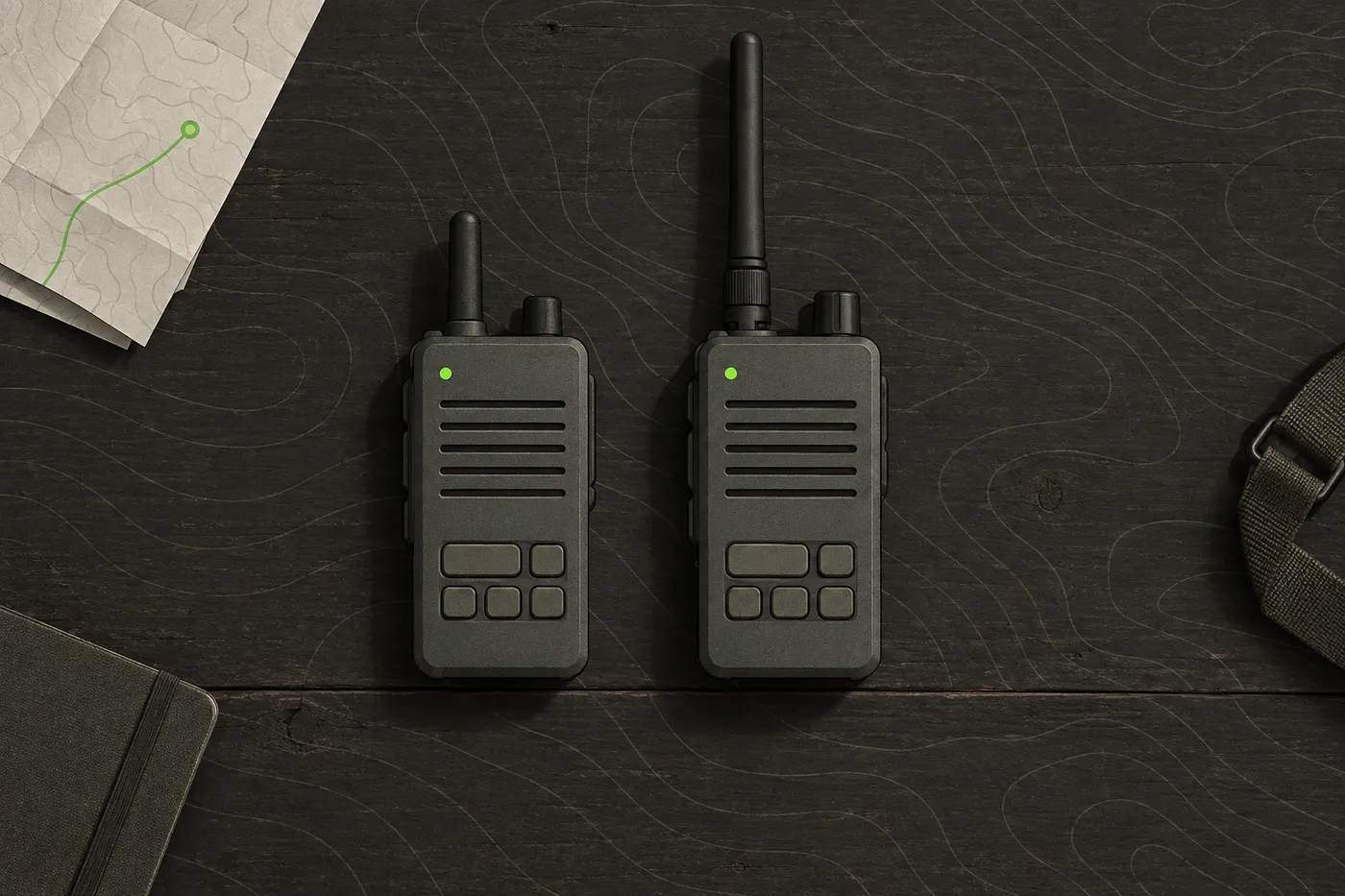
The catch is the antenna. FRS-only units have antennas built into the unit, while GMRS units may carry a detachable, higher-gain antenna, which is a large part of why GMRS reaches further.[3] You can’t bolt a bigger antenna onto an FRS radio and legally keep calling it FRS. Whatever range the radio shipped with is the range you get, on every channel, in every field condition.
A wrinkle worth knowing before you borrow or buy second-hand: some older radios were type-accepted for both FRS and GMRS and share the same channel numbers, but only a GMRS license holder may legally use the higher-power GMRS privileges on them.[1] Check the label or the manual before you assume a hand-me-down radio from a relative’s garage is FRS-only. Plenty of them aren’t, and the power switch doesn’t care whether you’ve filed anything with the FCC.
GMRS: what it does well and where it falls short
A single GMRS license covers the licensee’s immediate family members operating under that same license, which suits a household running a team together.[3] One filing, one fee, one family’s worth of radios on the channel without each person separately applying.
GMRS permits the use of repeaters on designated channels, giving organisers a communications range of one to twenty-five miles depending on terrain and station class.[2] That’s the real reason organisers pay for it. A repeater on high ground is one of the biggest range upgrades you can make for a sprawling milsim op spread across hundreds of acres of broken terrain, where a flat-power handheld simply can’t punch line of sight to every squad.
The tradeoff is that a repeater and a licensed base station are a bigger commitment than a bag of handhelds. Someone has to own the repeater, place it, and keep it running across the whole event, a real job rather than something you hand out at the gate.
Rules: a GMRS system may legally be operated only with an FCC license.[3] Borrowing a teammate’s GMRS radio without being covered by their license, or keying up on a GMRS repeater because it happens to reach further, breaks that rule the same way operating without any license would.
Choose FRS if, choose GMRS if
Choose FRS if:
- Your games are single-day, one field, casual, and you don’t want to deal with a license.
- Your squad already has a workable channel plan and proword list and just needs radios that work out of the box.
- Nobody on the team wants to be the one filing paperwork before a weekend game, and the field is small enough that nobody needs to.
Choose GMRS if:
- You organise recurring milsim ops, need repeater range, or want one license to cover a family of players.
- Your AO is big enough that FRS’s built-in antenna becomes the limiting factor well before the terrain or the squad’s radio discipline does.
- You’re already the team’s radio owner, you’ve started the team properly with roles and rules, and one more filing doesn’t change your life.
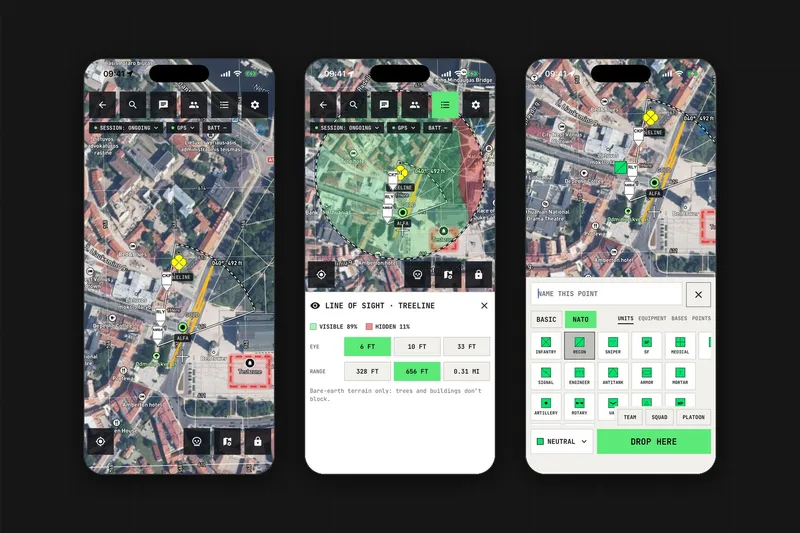
If you want to see where your team is on a map as well as hear them, Tacnav adds live positions over mobile data on top of whichever radio you pick. It doesn’t replace a radio plan, and it isn’t a TAK or Cursor on Target substitute: Tacnav is on the App Store, with Android access available on request while it’s in closed beta. Seeing where everyone is and hearing them are two different problems, and GMRS versus FRS only answers one of them.
Setting up a team of eight
A GMRS license lets the licensee and their immediate family operate the licensed system.[3] The FCC’s consumer guide doesn’t spell out, on that page, exactly where the line falls when your team of eight is friends rather than relatives. We can’t confirm from that page how far “immediate family” stretches for a mixed group, and we’re not going to guess at a legal line we can’t cite.
The cautious, practical answer most organisers land on: for a mixed group of friends who are not family, each adult who wants to transmit on GMRS files their own license. Filing is per person rather than per team, which sounds like more paperwork than it turns out to be. Spread across a season of games, the fee is a small line item next to radios, batteries and the rest of the gear list, and nobody ends up relying on someone else’s paperwork to stay on the right side of the rules.
A practical split for a team of eight: hand out FRS radios to anyone who just needs to hear the net, and let the two or three people who run the comms, the repeater or the base station carry GMRS licenses in their own name. You get GMRS’s range where it matters and keep the licensing simple everywhere else.

The bottom line
Bottom line: FRS covers most single-day games without paperwork. GMRS is worth the license the moment repeaters, family coverage or real range start to matter to your games.
Either way, the radio is only half the plan. A channel plan and a radio net that everyone follows on the day matters more on game day than which service is printed on the label. Buy radios for the games you run now, then upgrade to GMRS the day FRS genuinely runs out of range rather than the day it sounds more serious.
Disclaimer: This guide is general information for airsoft, milsim and paintball games and for people learning about publicly available TAK software, not military, tactical or legal advice. Follow your field’s and event’s safety rules, marshal instructions and local law. ATAK, iTAK, WinTAK and TAK Server belong to their respective owners; Tacnav is independent, not affiliated with the TAK Product Center, and not compatible with TAK or Cursor on Target. App features and prices change, so check the official listing before you rely on one.
Sources
- Family Radio Service (FRS). FCC, accessed Oct 7, 2026.
- General Mobile Radio Service (GMRS). FCC, accessed Oct 7, 2026.
- Personal Radio Services. FCC, accessed Oct 7, 2026.
Frequently asked questions
Do I need a license for FRS radios?
No. FRS is a license-free radio service, and an individual license is not required to operate an FRS radio provided you comply with the rules.
Do I need a license for GMRS radios?
Yes. GMRS requires an individual FCC license, valid for a ten-year term.
What is the range of GMRS versus FRS?
GMRS permits repeaters and gives a realistic range of one to twenty-five miles depending on terrain and station class. FRS's range is shorter because its antenna is built into the unit and can't be upgraded.
Can my whole airsoft team use one GMRS license?
A GMRS license covers the licensee and their immediate family. For a mixed group of friends who aren't family, the cautious approach is for each adult who wants to transmit to file their own license.
Is Tacnav compatible with TAK or Cursor on Target?
No. Tacnav adds live team positions over mobile data, but it is not a TAK or Cursor on Target substitute.
Tacnav
Put your whole team on one live map.
Positions, markers, routes and chat in a private session. Join with a QR code, no server to set up.