Military Alphabet: The NATO Phonetic Alphabet, Explained for Airsoft

TL;DR
The military alphabet is really the NATO phonetic alphabet, 26 fixed code words from Alfa to Zulu, one per letter, so names, call signs and grid references survive static on a radio. It is not military only. Pilots, airlines, IT workers and US public safety radio all use some version of it, and airsoft or milsim teams only need it once a game gets loud, multi squad and grid heavy.
Key takeaways
- The military alphabet is the NATO phonetic alphabet: one code word per letter, Alfa to Zulu.
- Civil aviation, airlines, IT workers and US public safety radio all use some version of it, not just the military.
- It costs nothing to use: no app, account, server or purchase, just memorizing 26 words.
- Small, short range skirmish squads rarely need it; multi squad milsim ops with grid references get real value from it.
- Tacnav players can copy an MGRS grid reference with a long press, then spell it out letter by letter over the radio.
On this page
The military alphabet most people mean is the NATO phonetic alphabet: a fixed set of 26 code words, Alfa to Zulu, one per letter, so a name, a grid reference or a call sign survives static on a radio.[1] NATO itself adopted a version of this alphabet, with changes from its own research, on 1 January 1956, around the same time the International Civil Aviation Organization finished its matching 26 word standard.[1] Most people typing “military alphabet” into a search bar mean exactly this list, even though the armed forces are only one of several users who made the name stick.
Here is the full chart, the same one pilots, dispatchers and airsoft squads all draw from.
| Letter | Code word | Letter | Code word |
|---|---|---|---|
| A | Alfa | N | November |
| B | Bravo | O | Oscar |
| C | Charlie | P | Papa |
| D | Delta | Q | Quebec |
| E | Echo | R | Romeo |
| F | Foxtrot | S | Sierra |
| G | Golf | T | Tango |
| H | Hotel | U | Uniform |
| I | India | V | Victor |
| J | Juliett | W | Whiskey |
| K | Kilo | X | Xray |
| L | Lima | Y | Yankee |
| M | Mike | Z | Zulu |
What it does in practice, on a radio
The real reason the alphabet exists is ordinary radio physics: static and interference make several letter names hard to tell apart, so spelling a word out with a distinct code word for each letter removes the ambiguity.[1] It does not need to replace normal speech. It only earns its place where a mistake is expensive.
In a game, that shows up in small moments. A squad leader calling in a flag capture over a crackling channel does not spell the whole sentence. They spell the parts that have to survive the static: the grid letter, the call sign, the one word that would otherwise get asked twice. “Charlie Three, flag secured, grid Delta Hotel niner eight” takes one transmission. The same message in plain speech, repeated because someone misheard “D” for “B”, takes three.
Bottom line: spell the grid letter, the call sign, the word that would get asked twice. Everything else can stay plain English.
Who uses it, and why
It was never a military only trick. Civil aviation runs pilot controller radio communication worldwide on this exact ICAO defined list.[1] Major airlines use it internally to read out passenger name records, sometimes with customers on the line, and IT workers use the same 26 words to read long serial numbers and reference codes aloud without errors.[1] US public safety radio has its own separate history here too: the APCO alphabet, used for decades by the Los Angeles Police Department and other local and state law enforcement agencies, was a competing alternative to the ICAO list rather than the same words under a different name.[2]
The short list of who reaches for it:
- Civil aviation, for pilot to controller radio calls, worldwide.
- Airlines and IT workers, for names, reference codes and serial numbers read aloud.
- US public safety radio, historically through its own, different APCO list.
- Airsoft and milsim teams, who borrowed the convention informally for the same reason as everyone else on this list: it cuts down on a callout that otherwise gets repeated.
What you need to get started
The honest setup cost is close to zero. The 26 words are free and public, with no app, account, server or purchase required, and most new players can drill the list in one evening before a game, usually on the drive out.
A simple way to learn it before your next op:
- Read the chart above out loud, letter by letter, once a day for a week.
- Practice spelling your own call sign and your squad’s grid callouts, the parts you will use mid-game.
- Use it for real on the first briefing of your next game, even if half the squad still hesitates on “Quebec.”
It is worth knowing the list was not always this tidy. Before 1956, the wartime Allied militaries, mainly the US and the UK, each ran their own radiotelephone spelling alphabets, with roots back to the First World War, and those evolved separately across different services in both countries.[3] That history is why an old film, a surplus manual or a grandfather’s service record can use words that do not match the chart above.
Do you need it for airsoft or milsim?
A weekend skirmish squad of six to ten players on one short range channel rarely needs it. Plain English callouts are faster, and nobody is parsing static at fifty meters.
A multi squad milsim operation running grid references and call signs across a shared channel and a few hundred meters of trees gets real value from it. A misheard callout costs more time mid op than teaching the alphabet at the pre game brief.
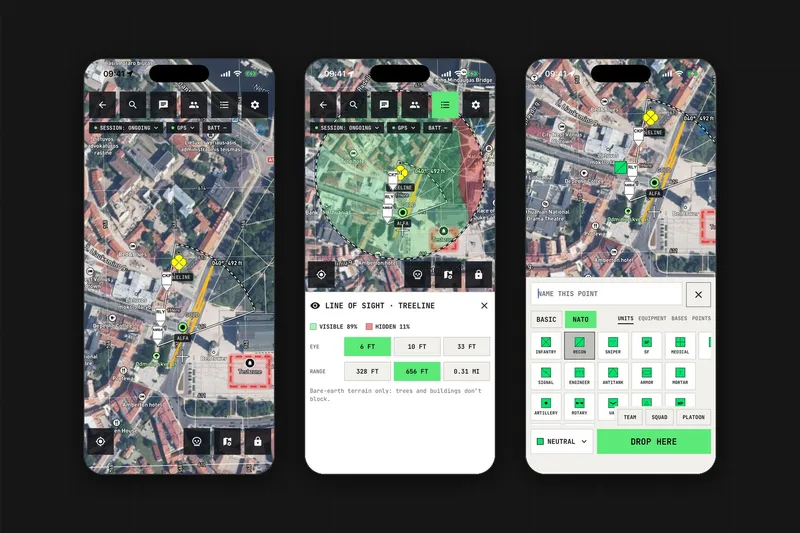
If your team is already running Tacnav to share one map, this is where the alphabet earns its keep twice over. Long press any point on the map and copy its MGRS grid reference, then read that string back over the radio letter by letter instead of guessing at a run of digits and letters down a bad connection. Tacnav is free to download for iPhone now; Android access is available on request during its closed beta.
Bottom line: small, short range games do not need the alphabet. Bigger, noisier, multi squad ops do, especially once grid references are in the mix.
Where to go next
This page stays on the alphabet itself on purpose. If your organisers want the fuller radio vocabulary, prowords, brevity codes and the different kinds of call sign, those live in their own guides: Walkie Talkie Lingo: Prowords, Codes and the Phonetic Alphabet covers the rest of the vocabulary, and Radio etiquette for airsoft and milsim covers how to run a channel without stepping on every transmission. If your team’s radios need a license in the first place, start with FRS vs GMRS: which radio service your airsoft team needs.
Save or print the chart above. It is the whole standard, and nothing in it changes from one game to the next.
Disclaimer: This guide is general information for airsoft, milsim and paintball games and for people learning about publicly available TAK software, not military, tactical or legal advice. Follow your field’s and event’s safety rules, marshal instructions and local law. ATAK, iTAK, WinTAK and TAK Server belong to their respective owners; Tacnav is independent, not affiliated with the TAK Product Center, and not compatible with TAK or Cursor on Target. App features and prices change, so check the official listing before you rely on one.
Sources
- NATO phonetic alphabet. Wikipedia, accessed Oct 9, 2026.
- APCO radiotelephony spelling alphabet. Wikipedia, accessed Oct 9, 2026.
- Allied military phonetic spelling alphabets. Wikipedia, accessed Oct 9, 2026.
Frequently asked questions
What is the military alphabet actually called?
Officially it is the NATO phonetic alphabet, a fixed set of 26 code words, one per letter, used so radio calls are not misheard.
Is the military alphabet only used by the military?
No. Civil aviation, major airlines, IT workers reading out serial numbers and US public safety radio all use some version of the same idea, alongside the military.
Do airsoft and milsim teams need to learn it?
A small weekend skirmish squad on a short range channel rarely needs it. A multi squad milsim operation using grid references and call signs across a shared channel gets real value from it.
How long does it take to learn the military alphabet?
Most new players can drill the 26 words in one evening before a game, since it needs no app, account or purchase.
Did the military alphabet always use the same words?
No. Before 1956, the wartime Allied militaries, mainly the US and the UK, each used their own, different spelling alphabets that had evolved separately across services.
Tacnav
Put your whole team on one live map.
Positions, markers, routes and chat in a private session. Join with a QR code, no server to set up.