Walkie Talkie Lingo: Prowords, Codes and the Phonetic Alphabet

TL;DR
Walkie talkie lingo means prowords like over and roger, the NATO phonetic alphabet, and numeric codes like 10-4, used to keep radio messages short and clear. A new team should start with plain language plus a few prowords, check whether their radio needs a licence, and add codes only once the basics are solid.
Key takeaways
- Prowords such as over, roger and say again keep radio traffic short and unambiguous.
- FRS radios need no licence in the US, GMRS does, and PMR446 in Europe is licence-free with its own limits.
- The NATO phonetic alphabet helps most for spelling call signs and grid references, not everyday chat.
- A shared map, like Tacnav's, cuts how much needs to be said over the radio but does not replace prowords.
- ATAK and a TAK Server suit a team that already has that infrastructure; Tacnav is a simpler alternative, not a TAK replacement.
On this page
Walkie talkie lingo is the shared set of prowords, phonetic alphabet letters and numeric codes radio users say instead of plain sentences, so a message survives static, a dropped syllable or someone keying up over the first half of your transmission. If your squad’s radio net turns into cross-talk every game, or you searched ATAK and want to know how it fits into all this, this guide covers both.
This guide covers:
- What prowords, the phonetic alphabet and numeric codes mean, and where each comes from
- Which walkie talkies need a licence before you key the mic
- How a shared map changes how much of this you need to say out loud
- A straight comparison of the systems, and the two or three worth learning first
Airsoft and milsim teams borrow this vocabulary to run tighter games. People who searched ATAK, iTAK or TAK Server usually want a different answer: how that software handles the same radio traffic, and whether it beats a walkie talkie outright. We will get to both.
Licensing comes first, before any lingo, because it decides what radio you are even allowed to use. In the United States, small FRS-only walkie talkies can be used without a licence, while GMRS radios, which share some channels with FRS but transmit at higher power, need an FCC licence[1]. If you are buying radios for a game, check which one you are holding before you assume you are covered.
The vocabulary: prowords, phonetic alphabet, codes and radio types
There are four things people mean when they say “walkie talkie lingo.” They are not interchangeable, and a new team does not need all four.
Prowords
Prowords such as over, roger, copy, wilco, say again and out are short standard phrases that tell the other radio user exactly what to do next without wasting airtime. “Over” means you are done talking and expect a reply. “Out” means the conversation is finished. “Say again” asks for a repeat, not “come again” or “what.” These are the load-bearing words of any radio net, game or otherwise, because they remove guesswork about whose turn it is to speak.
The phonetic alphabet
The NATO phonetic alphabet, which spells letters as Alpha, Bravo, Charlie and so on, was standardised by the International Civil Aviation Organization to stop similar-sounding letters being confused over radio[2]. It matters most for spelling call signs, grid squares or vehicle plates, anything where “B” and “D” sounding alike over static could send someone to the wrong rally point. You do not need the full alphabet memorised on day one. Learning it for the letters your own call signs use is enough to start.
Numeric codes
Ten-codes such as 10-4 for message received began with US police radio systems in the 1930s and later spread into CB radio and civilian walkie talkie use[3]. They are compact, but they are also the least standard part of this list: a 10-20 means “location” to one group and something else to another. If your team adopts numeric codes, write down the exact list you are using and hand it out before the game, rather than assuming everyone learned the same version somewhere else.
Radio types (and their licences)
Which lingo you even need depends partly on which radio you bought. PMR446 walkie talkies, common in Europe, operate licence-free on a fixed set of short-range UHF channels under standardised power limits, distinct from the FRS and GMRS bands used in the US[4]. A radio bought for one region will not necessarily be legal, or even the same service, in another. Check the box before you cross a border with it.
| Service | Region | Licence needed | Typical use |
|---|---|---|---|
| FRS | United States | No | Small hand-held, short range |
| GMRS | United States | Yes, FCC licence | Higher power, longer range |
| PMR446 | Europe and others | No | Short-range hand-held |
Running it on a shared map
Radio lingo exists because a voice channel is the only way a team shares information. Once everyone is looking at the same map, some of that load moves off the radio entirely.
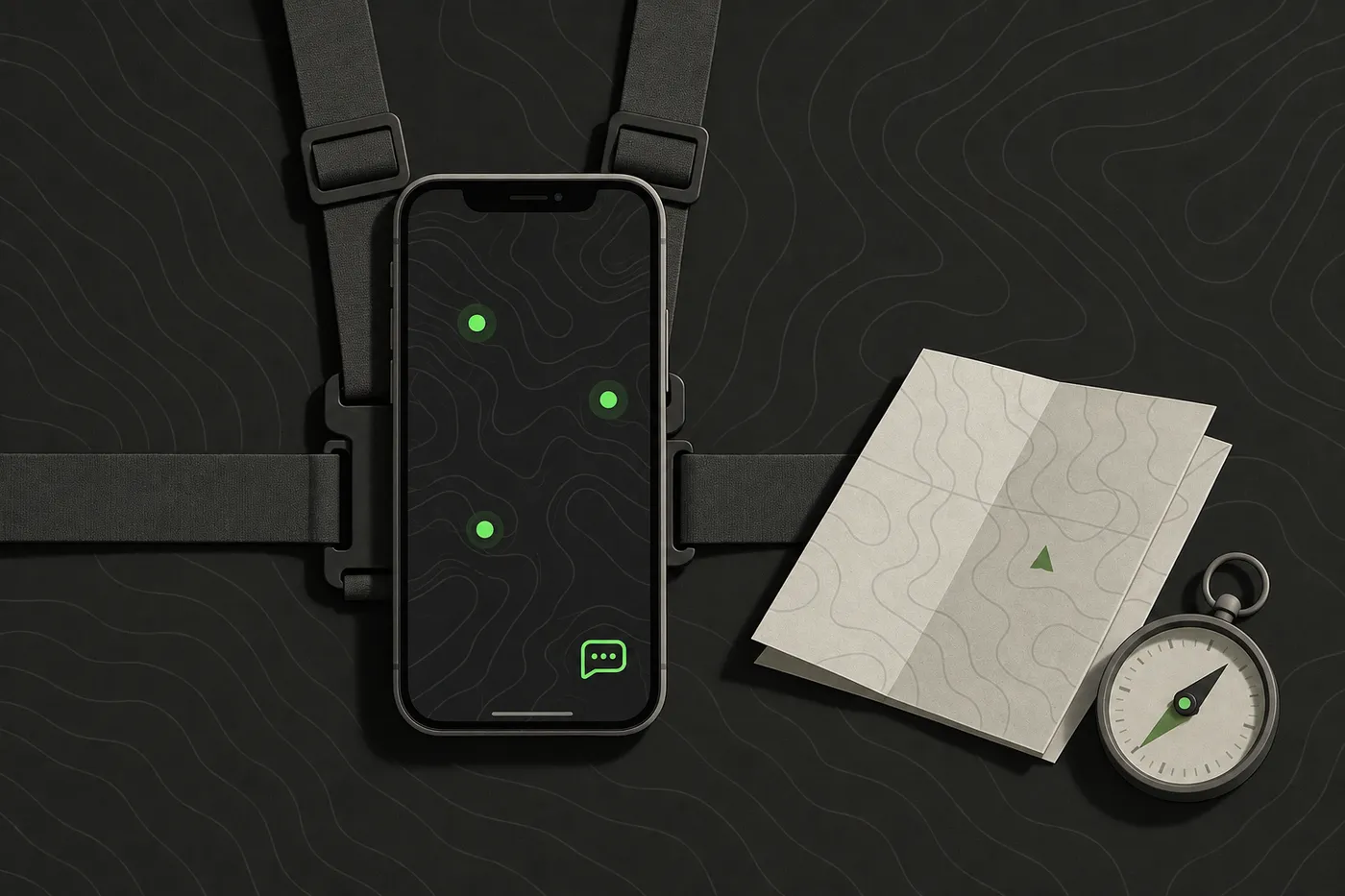
Tacnav’s session chat carries text, photos and voice notes with @-mentions, so a route change or a photo of a marked-up map does not have to be read out letter by letter over the net. Colour-coded squads and live positions on the same shared map remove much of the need to call out grid references or describe a location mid-game. That is not a replacement for prowords (you still need “over” and “out” to run a clean net) but it does mean fewer transmissions fighting for the same channel.
Bottom line: a shared map cuts the amount of lingo a team needs, it does not replace it.
People who search ATAK usually want to know whether it does the same thing, and better. For a team already running TAK infrastructure, the answer is often yes. TAK Server brokers and stores data, including chat, between TAK clients when they are not on a peer-to-peer network, which suits a team that already runs that infrastructure[5]. If your organisation already has a TAK Server and people trained on it, that is the better tool for the job. TAK server and FreeTAKServer: does your airsoft team need one? covers what running one involves.
Tacnav does not speak Cursor on Target and is not a TAK replacement. It is built for a different problem: a team with no server, no TAK experience and a game starting in twenty minutes. iTAK is a free download from the App Store, the same official-store route Tacnav uses for its own iPhone app[6]. If your team wants a shared map and chat without standing up a server, Tacnav is worth the look; Android access is currently by request at tac-nav.com/support.
Comparison
None of these systems is compulsory. Most airsoft and milsim teams mix a handful of prowords with plain language rather than adopting a full military brevity code, and that is a reasonable default for a Sunday skirmish.
| System | Learning curve | Best for | Risk |
|---|---|---|---|
| Prowords only | Low | New teams, casual games | None, worth learning regardless |
| Prowords + phonetic alphabet | Low to medium | Spelling call signs and grids | Slower until practiced |
| Numeric codes | Medium | Established teams with a written list | Meaningless if not standardised across the team |
We could not confirm a specific published call sign rule from any large milsim organiser through a page we can cite here (the detailed rules we found exist only as PDFs, not a page we could check against the source list for this guide). What we can say plainly: organisers who publish written comms rules at all consistently ask for call signs instead of real names on the radio, for the ordinary reason that a real name tells nobody’s position or role.
Practical tips
- Brief the channel, the call signs and the two or three prowords the team will use before the first game starts, rather than assuming everyone remembers the same list from a video they watched once.
- Keep transmissions short and end them with over or out consistently. A radio user who does not know whether the other side is finished will talk over them, and now you have said the same thing twice and missed the reply.
- Pick three to five codes or call signs and drill them, rather than issuing a full lexicon. A short list survives adrenaline and static far better than a long one nobody remembers past the first objective.
Where to start
Start with plain language plus a handful of prowords and the phonetic alphabet for spelling call signs, and add numeric codes later, only if the team uses them consistently. That order gets a new team communicating cleanly in one briefing instead of three.
A shared map that shows squad positions and markers, such as Tacnav’s, takes some of the pressure off verbal lingo by handling routine position and status updates visually instead of over the net. The radio still matters. It just has to carry less.
Disclaimer: This guide is general information for airsoft, milsim and paintball games and for people learning about publicly available TAK software, not military, tactical or legal advice. Follow your field’s and event’s safety rules, marshal instructions and local law. ATAK, iTAK, WinTAK and TAK Server belong to their respective owners; Tacnav is independent, not affiliated with the TAK Product Center, and not compatible with TAK or Cursor on Target. App features and prices change, so check the official listing before you rely on one.
Sources
- Family Radio Service (FRS). Federal Communications Commission, accessed Sep 28, 2026.
- NATO phonetic alphabet. Wikipedia, accessed Sep 28, 2026.
- Ten-code. Wikipedia, accessed Sep 28, 2026.
- PMR446. Wikipedia, accessed Sep 28, 2026.
- TAK Product Lines. TAK Product Center, accessed Sep 28, 2026.
- iTAK on the App Store. Apple App Store, accessed Sep 28, 2026.
Frequently asked questions
What does 10-4 mean on a walkie talkie?
10-4 is a ten-code meaning message received. Ten-codes like this began with US police radio systems in the 1930s and later spread into CB radio and civilian walkie talkie use.
Do you need a licence for a walkie talkie?
In the United States, small FRS-only walkie talkies can be used without a licence, while GMRS radios, which share some channels with FRS but transmit at higher power, need an FCC licence. In Europe, PMR446 radios are licence-free under their own set channels and power limits.
What is the phonetic alphabet used for on a radio?
The NATO phonetic alphabet spells letters as Alpha, Bravo, Charlie and so on to stop similar-sounding letters being confused over radio. It matters most for spelling call signs, grid squares or vehicle plates.
Is iTAK free?
Yes, iTAK is a free download from the App Store, the same official-store route Tacnav uses for its own iPhone app.
Does Tacnav work with ATAK or TAK Server?
No. Tacnav does not speak Cursor on Target and is not a TAK replacement. It is built for a team with no server and no TAK experience, while ATAK with a TAK Server suits a team that already runs that infrastructure.
Tacnav
Put your whole team on one live map.
Positions, markers, routes and chat in a private session. Join with a QR code, no server to set up.