How to organize a milsim event: a step-by-step checklist

TL;DR
To organize a milsim event, secure a site with written permission, publish a rules pack with a safety and medical plan, cap registration, and send a radio and map plan before game day. For a first weekend event of 40 to 80 players, start about 10 to 12 weeks out, and rehearse comms and safety rather than leaving them to the day.
Key takeaways
- Split the work between a game director, a safety lead, a comms and map lead and an admin lead.
- Publish the waiver, rules, kit list and velocity limits before registration opens, with a hard player cap.
- Plan one channel per faction, a command channel and a safety channel, and run a radio check before the first game.
- Eye protection, chrono tests, a set minimum engagement distance and a briefed stop call are the safety basics.
- Close every event with an after-action review focused on what to change next time.
On this page
To organize a milsim event, you need a site with written permission from the landowner, a published rule set with a safety and medical plan, capped registration, a radio and map plan, and a small staff where each person owns one job. For a first weekend event of 40 to 80 players, start about 10 to 12 weeks out. The most common mistake is treating comms and safety as game-day details: they have to be written down, sent out and rehearsed before anyone arrives.
Milsim is airsoft with a story, a longer clock and a lot more logistics. Large milsim events usually have rigid requirements for entry and can last several days without players leaving the playfield.[1] You do not need to start that big, but you do need to plan as if you might.
What you need before you start
- A core staff of four. A game director, a safety lead, a comms and map lead, and an admin lead for registration and logistics. One person doing all four burns out by Saturday lunch.
- Marshals. Enough that every area of play has one in sight. They are staff and do not play.
- A site and written permission from the landowner or site operator, with agreed boundaries, parking and access times.
- Insurance. Most established sites and clubs carry public liability cover. Ask what it covers for an outside event, and whether you need your own. Rules differ by country, so we do not quote a requirement here.
- A rules pack. Waiver, rules document, kit list and velocity limits, published before registration opens.
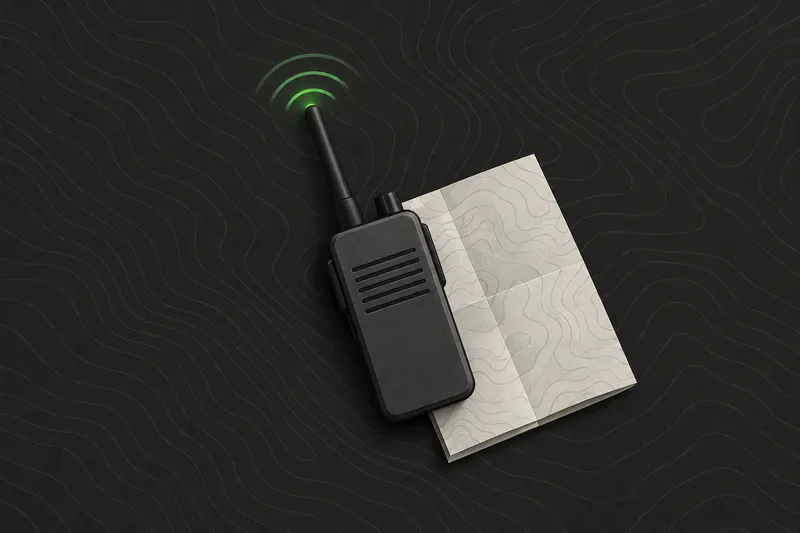
- Radios. At milsim events, players must often source their own equipment, such as specific uniforms and radios.[1] Tell them which radio service and channels to program in advance.
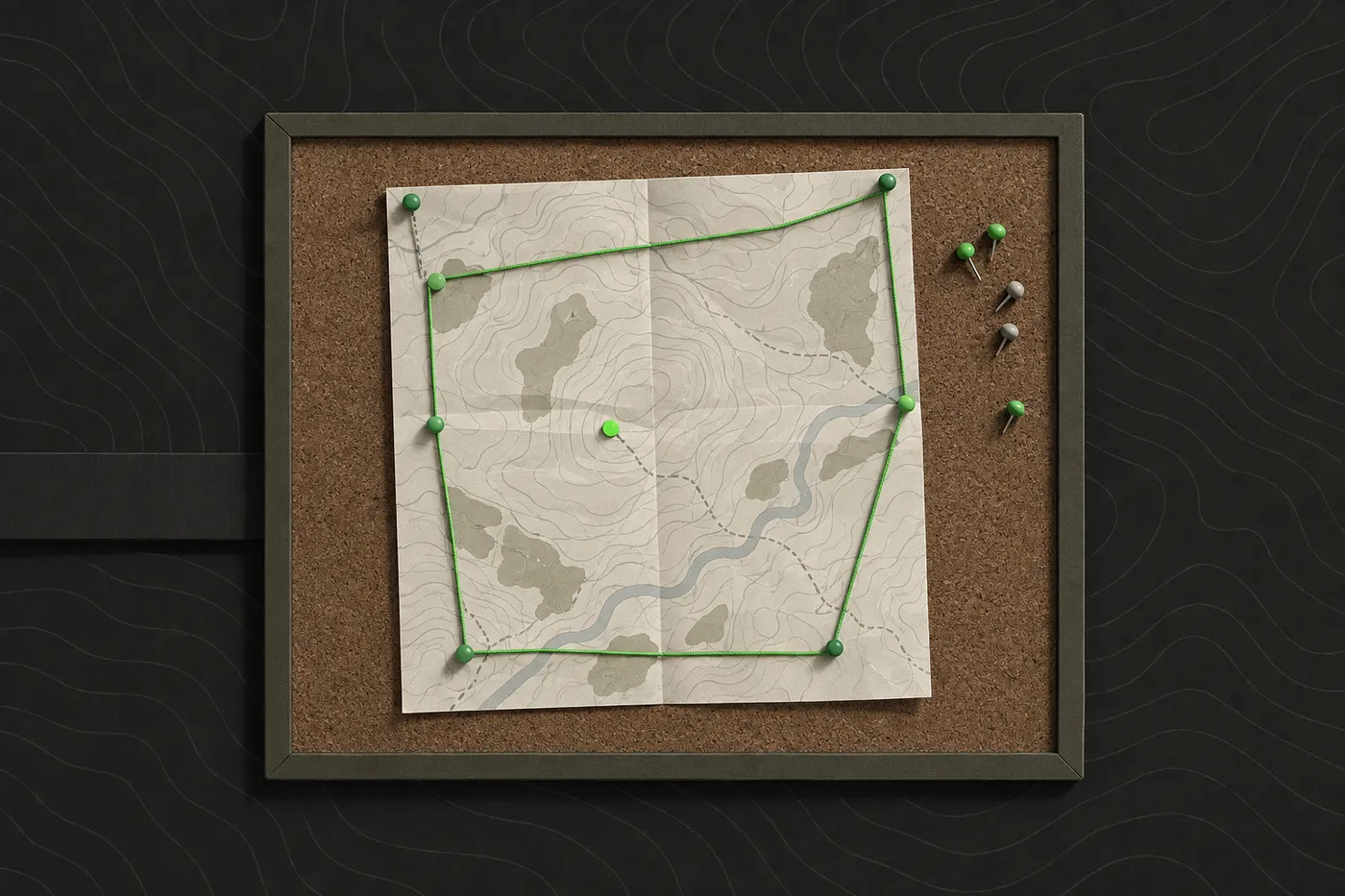
- A map. A printed site map for every squad leader, and a shared live map if you can.
If your group already runs ATAK with a TAK Server, keep it. The ATAK-CIV listing on Google Play (checked September 2026) says its networking component brokers communication with the TAK Server product,[2] which matters if your players or a partner club are already on TAK. Our plain-English guide to ATAK covers when that setup is worth it.
How many players should a first event take?
Take fewer than you think. A first event that sells 50 places and runs smoothly earns a second event. One that sells 150 and runs out of water, marshals and parking does not.
The organiser checklist
| Phase | Task | Owner | When |
|---|---|---|---|
| Planning | Confirm the site, dates and written landowner or operator permission; check local rules | Game director | 12 weeks out |
| Planning | Confirm insurance cover with the site or a club | Admin lead | 12 weeks out |
| Planning | Write the scenario, factions and objectives | Game director | 10 weeks out |
| Planning | Publish the rules pack: waiver, rules, kit list, velocity limits, engagement distances | Safety lead | 8 weeks out |
| Registration | Open registration with a hard player cap | Admin lead | 8 weeks out |
| Registration | Close registration; assign factions, squads and squad leaders | Admin lead | 2 weeks out |
| Comms and maps | Send the radio channel plan and callsign list | Comms and map lead | 2 weeks out |
| Comms and maps | Mark objectives, boundaries, no-go zones and the safe zone on the map | Comms and map lead | 1 week out |
| Safety | Write the medical plan: first aiders, kit, casualty point, vehicle access, nearest hospital | Safety lead | 1 week out |
| Logistics | Book water, food, toilets, parking marshals and lighting | Admin lead | 1 week out |
| Game day | Registration desk, waiver check, chrono every replica | Safety lead and marshals | Before the first briefing |
| Game day | Safety briefing, command briefing, radio check | Game director | Before the first game |
| Game day | Marshals on the field, organiser watching the map | Marshals and game director | Throughout |
| After | Site clear-up and lost property | All staff | Same day |
| After | After-action review with squad leaders and staff | Game director | Within a week |
The steps, in order
Step 1: Secure the site and check local rules
Get permission in writing, with the boundaries marked on a map both of you sign off. Laws in many countries regulate both the sport of airsoft and the airsoft guns themselves,[3] so check with the site operator or your national airsoft association before you announce a date.
Step 2: Write the scenario and factions
Two or three factions, each with a reason to move and objectives that can be held or completed. Keep the story to one page, because players spend their time on the map.
Step 3: Publish the rules pack and open registration
Put everything players must agree to in one place before they pay. US milsim organiser MilSim West publishes a waiver, a separate minor waiver and a rules document called the TACSOP, which it describes as everything to know before attending an event.[4] It also asks players to fill out all registration information accurately and completely, and states that its tickets are non-refundable and non-transferable, with an exception for active duty military on orders.[5] Set a hard player cap and a closing date, and collect callsign, faction preference, emergency contact and radio model at sign-up.
Step 4: Build the comms plan
One channel per faction, a command channel for squad leaders and staff, and a safety channel every radio can reach. In Europe, PMR446 is a licence-exempt personal radio service on 446 MHz, available for business and personal use in most European Union countries and the United Kingdom.[6] In the United States, the Family Radio Service (FRS) is a walkie-talkie radio system that uses channelized frequencies around 462 and 467 MHz.[7] Send the channel plan and callsign list two weeks out, printed on a card that fits a pouch.
Step 5: Build the map
Every squad leader gets the same printed map with boundaries, objectives, the safe zone and the casualty point.
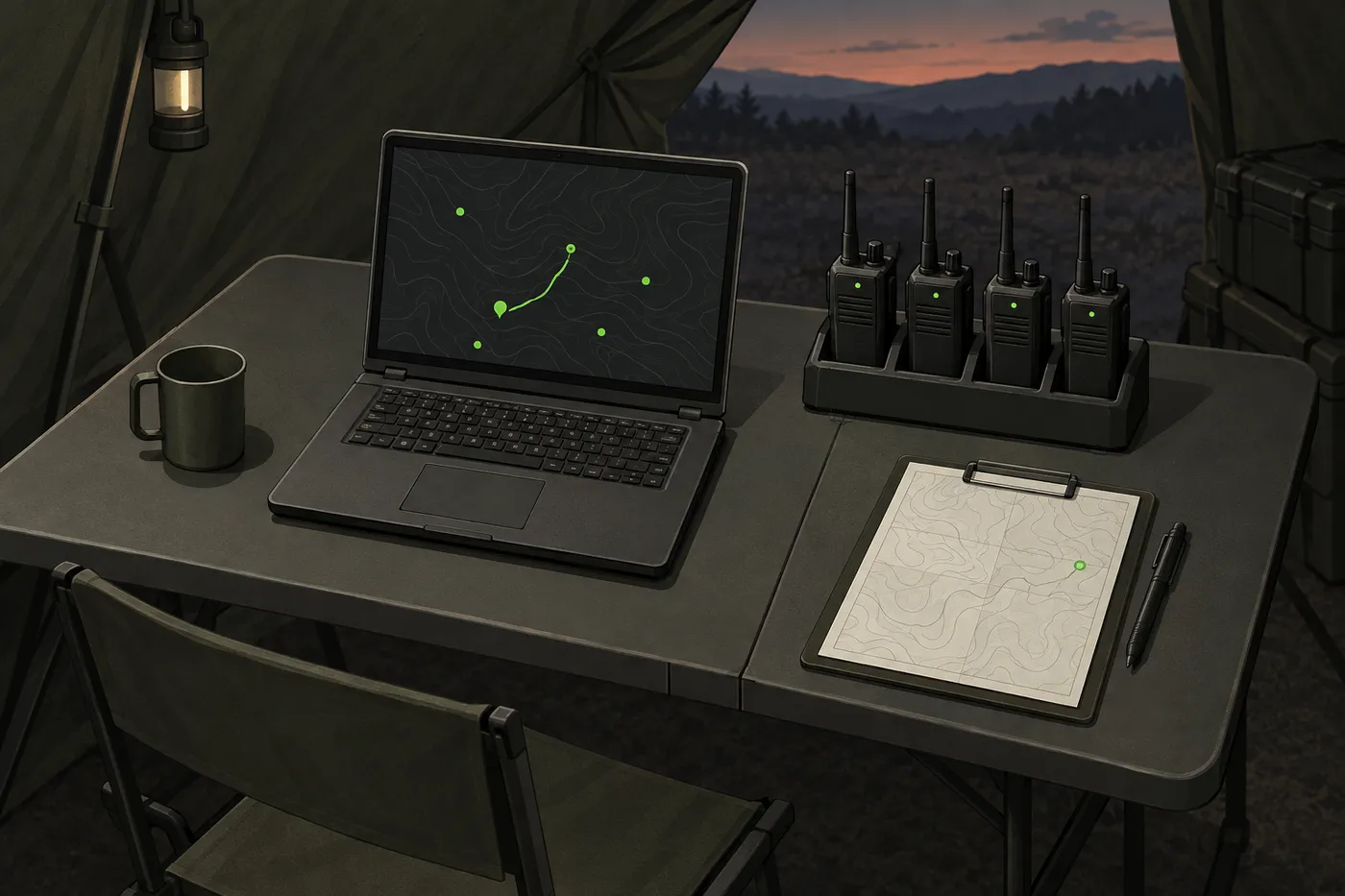
This is also where a shared live map earns its place. In Tacnav, the organiser creates a private session and players join by scanning a QR code. From the web command post at app.tac-nav.com you watch every squad live, drop objectives as markers, draw boundaries and no-go zones, share the mission briefing in the app, and see who is marked injured. You can also pin your own hand-drawn field map onto the real map, and markers and messages queue until a weak signal comes back.
Tacnav is on the App Store, and Android is in closed beta (request Android access). It does not connect to TAK, so a club already on TAK should stay there.
Step 6: Write the safety and medical plan
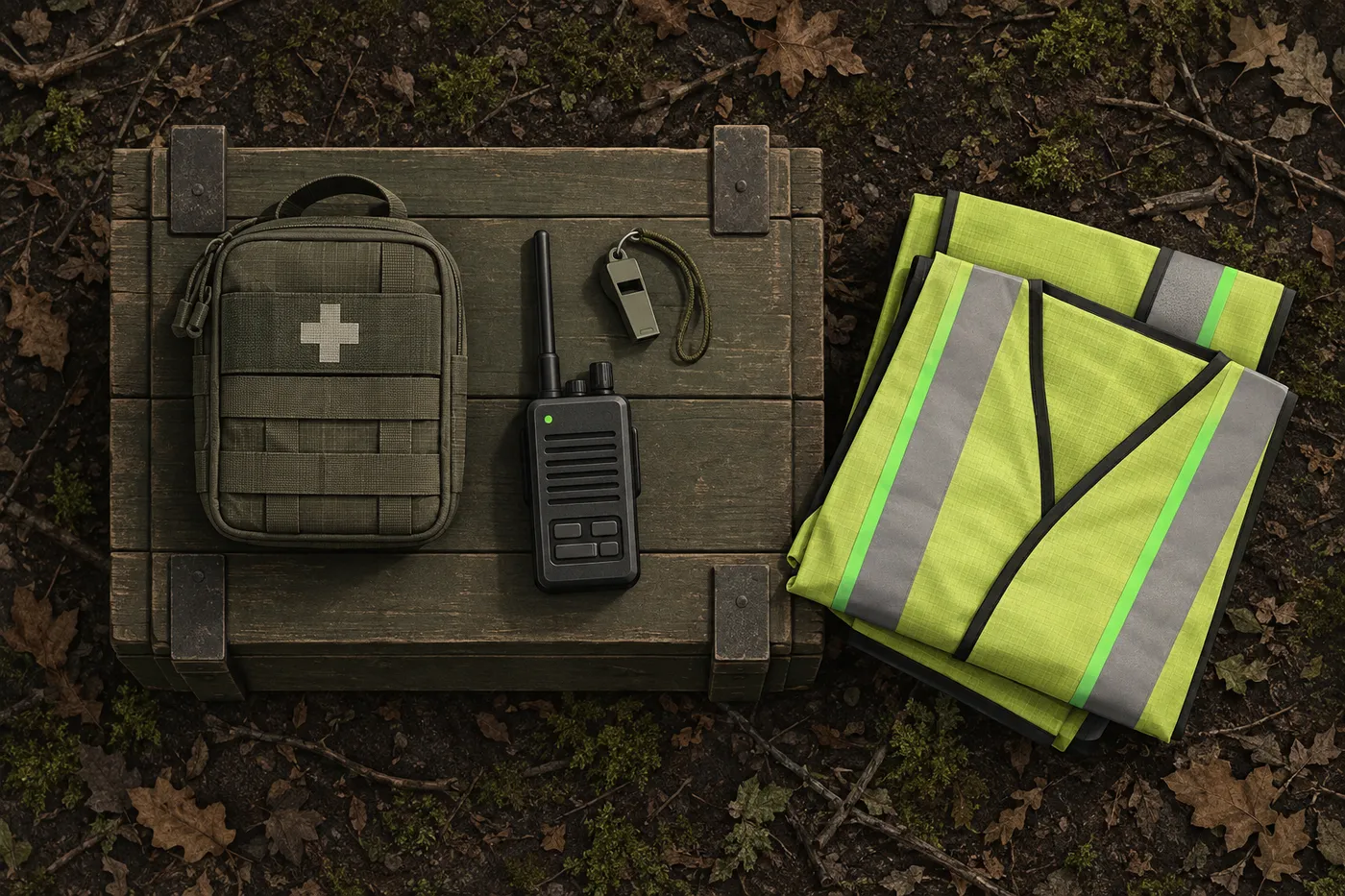
Name your first aiders and where the kit lives, mark a casualty collection point and a vehicle route to it, and write down the nearest hospital and how to reach it. Check phone signal at the casualty point before game day, and brief the stop call to every player and marshal.
Step 7: Sort the logistics
The milsim experience often includes camping, food preparation and transportation.[1] Plan drinking water per player per day, toilets, parking with a marshal, rubbish collection and lighting for the safe zone. Water is the item most often left to “someone”.
Step 8: Run game day
Open the registration desk early: check waivers, chrono every replica and tag it. Milsim players are often given an extensive briefing containing storylines, mission tactics and rules of engagement.[1] Run the safety briefing first, the command briefing second, then a radio check on every channel before the first game starts.
Step 9: Close out with an after-action review
An after-action review compares the intended outcome with the actual outcome and identifies practices to sustain and practices to improve.[8] Do it within a week, with squad leaders and staff, and keep it about what to change next time, with no blame.
Roles: who owns what
- Game director. Scenario, briefings, final say on rule calls. Needs the map, the timeline and a radio on the command channel.
- Safety lead. Chrono, medical plan, marshal briefing, stop calls. Needs the first-aid kit, a chronograph and the safety channel.
- Comms and map lead. Channel plan, callsigns, the printed and live map. Needs a spare radio, spare batteries and the organiser view of the map.
- Admin lead. Registration, waivers, money, food, water, parking. Needs the player list with emergency contacts.
- Marshals. At MilSim West, the cadre’s responsibility is to supervise, assist and coordinate the execution of all its events.[9] In paintball, regulated games are overseen by referees or marshals who patrol the course to enforce the rules and keep players safe.[10] Give yours hi-vis, a radio on the safety channel and the authority to stop play.
Safety and rules
Safety: eye protection stays on from the moment a player leaves the safe zone until they are back in it. No exceptions for photos, fogged lenses or “just checking the map”.
The minimum safe gear for most airsoft games includes ANSI Z87.1 eye protection, preferably fully sealed APEL-rated ballistic eyewear.[11] Masks, face shields and other full-face coverings are recommended at most airsoft fields.[11]
- Chrono everything. Many airsoft venues set strict limits on maximum muzzle velocity and require each player to undergo a chronograph test before playing.[12] Publish your limits per replica type in the rules pack so nobody finds out at the desk.
- Minimum engagement distances. Muzzle velocity and engagement distance rules vary between groups, and most minimum engagement distances are 10 feet (3 m).[11] Set yours, write it down and brief it.
- Hit calling. Airsoft pellets leave no visible marks, so the sport relies heavily on an honour system in which players acknowledge being hit.[11] Marshals enforce it; the rules pack says what happens when it breaks.
- The stop call. Pick one phrase for “stop all play now” (many sites use “blind man”), brief it, and make sure it is repeated on the safety channel.
- Safe zone. Barrels bagged, magazines out, eye protection off only inside it.
- Medical. First aiders known to every marshal, kit at the casualty point, vehicle access kept clear.
Common mistakes
- A radio plan nobody rehearsed. The most common game-day failure. Fix: radio check on every channel in the safe zone before the first game.
- Too many players for the site. Fix: a hard cap set by the size of the field and the number of marshals you have.
- No written consequence for cheating. MilSim West’s golden rules say participants found cheating or disrespecting staff and other participants will be ejected from the event without a refund.[4] Fix: write your own rule and brief it.
- A briefing that runs 45 minutes. Fix: one page, one map, questions at the end.
- Nobody owns water. Fix: it goes on the admin lead’s list with a quantity.
- Skipping the debrief. Fix: book the after-action review date when you set the event date.
Bottom line: a good milsim event is a written plan that every player has read: site, rules, safety, comms and map. Get those five right and the game takes care of itself.
Disclaimer: This guide is general information for airsoft, milsim and paintball games and for people learning about publicly available TAK software, not military, tactical or legal advice. Follow your field’s and event’s safety rules, marshal instructions and local law. ATAK, iTAK, WinTAK and TAK Server belong to their respective owners; Tacnav is independent, not affiliated with the TAK Product Center, and not compatible with TAK or Cursor on Target. App features and prices change, so check the official listing before you rely on one.
Sources
- MilSim. Wikipedia, accessed Sep 25, 2026.
- ATAK-CIV (Civil Use). Google Play, accessed Sep 25, 2026.
- Legal issues in airsoft. Wikipedia, accessed Sep 25, 2026.
- TACSOP/DOCS. MilSim West, accessed Sep 25, 2026.
- Tickets. MilSim West, accessed Sep 25, 2026.
- PMR446. Wikipedia, accessed Sep 25, 2026.
- Family Radio Service. Wikipedia, accessed Sep 25, 2026.
- After-action review. Wikipedia, accessed Sep 25, 2026.
- MSW Cadre. MilSim West, accessed Sep 25, 2026.
- Paintball. Wikipedia, accessed Sep 25, 2026.
- Airsoft. Wikipedia, accessed Sep 25, 2026.
- Airsoft pellets. Wikipedia, accessed Sep 25, 2026.
Frequently asked questions
How far ahead should you start planning a milsim event?
For a first weekend event of 40 to 80 players, start about 10 to 12 weeks out. That leaves time to confirm the site, publish the rules pack and run registration before the final two weeks of comms and map planning.
How many players should a first milsim event take?
Fewer than you think. A first event that sells 50 places and runs smoothly earns a second event, while one that runs out of water, marshals and parking does not.
What safety rules does a milsim event need?
Eye protection outside the safe zone, a chronograph test for every replica against published velocity limits, a minimum engagement distance, honest hit calling and a briefed stop call. Most minimum engagement distances in airsoft are 10 feet (3 m), but every group sets its own.
What radios should players use at a milsim event?
Licence-free handheld radios are the usual choice: PMR446 in most of Europe and the Family Radio Service (FRS) in the United States. Send the channel plan and callsign list about two weeks before the event.
Do you need ATAK to run a milsim event?
No. If your group already runs ATAK with a TAK Server, keep it; otherwise a printed map for every squad leader plus a shared live map such as Tacnav covers most games. Tacnav does not connect to TAK.
Tacnav
Put your whole team on one live map.
Positions, markers, routes and chat in a private session. Join with a QR code, no server to set up.